
Serialized in the magazine Circus between 1979 and 19841, The Passengers of the Wind (Les Passagers du vent) helped French readers recognize the maturity comics could achieve. It was not the first French-language comic to address adult themes with subtlety, but many readers saw it as one.
With good reason, in a way: the story is full of strengths. Yet the work's reputation has faded somewhat over the years, in part because The Passengers... draws heavily on popular fiction. Bourgeon embraces this openly. In a 2014 interview with Le Monde, he said2: « There are different ways of approaching the profession of comics creator. For me, it is a craft of storytelling, intended to reach a wide audience, not an artist's practice for galleries or private collectors. My job is to tell stories: that is what I am known for. »
But François Bourgeon (born in 1945), the series' writer and artist, avoids some of the genre's clichés by offering a meticulously researched reconstruction of the world he depicts—in broad terms, the transatlantic slave trade at the end of the eighteenth century.
« My job is to tell stories: that is what I am known for. »François Bourgeon
Accidental adventurers
Bourgeon has sometimes been criticized for relying too heavily on historical material, though that criticism applies mainly to his later works. Even so, the first Passengers of the Wind series, like The Companions of the Dusk, stands out for its extraordinary dramatic control, its use of ellipsis, and its sweeping narrative.
Isa, a young woman from a respectable family who has lost her identity following a family scandal, falls in love with Hoël, a Breton sailor who has (unintentionally) committed murder to protect her. Together with Mary, an Englishwoman for whom Isa once worked as a governess, they flee French justice by boarding the Marie-Caroline, bound for Africa. On the shores of Dahomey (present-day Benin), they encounter the grip of passion and the horrors of the transatlantic slave trade; their return voyage is marked by a bloody mutiny. Isa and Hoël may seem drawn to adventure, but here they endure it rather than choose it. We come to care for them—and the others—as fellow travelers.
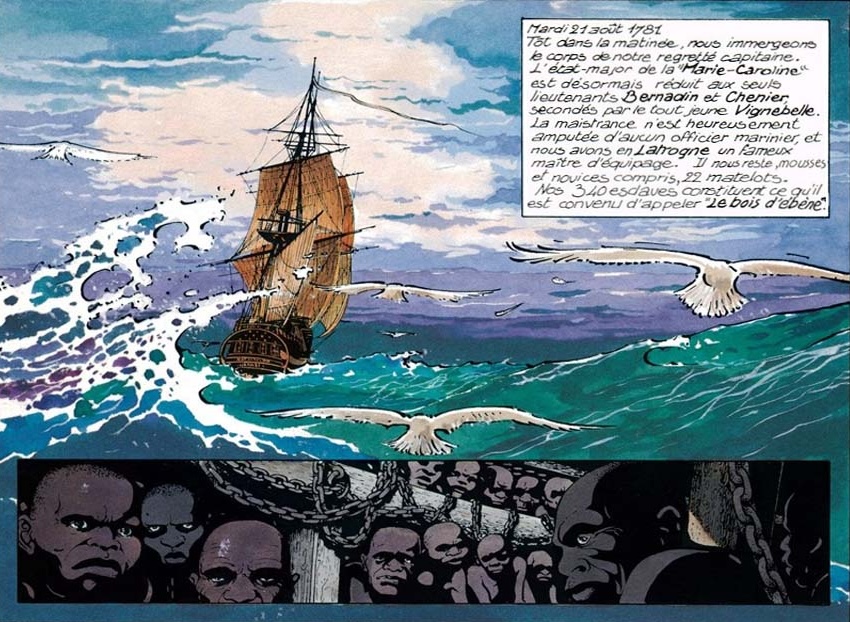
The Passengers of the Wind gives considerable space to women: Isa, Mary, of course, but also Alihosi, an enslaved Black woman. They are often eroticized, despite their youth; Isa is also an archetype of the independent woman, which gives her sexualization some meaning within the story's historical context. More broadly, the comic systematically dismantles hierarchies: the « savages » are placed on equal footing with the « civilized ». Male dominance is also widely questioned, decades before #MeToo. The work is clearly anti-imperialist, not merely anticolonial, and is feminist in its own way. It also depicts cruelty without flinching. The ending is striking: ironic, ultimately unsparing, yet still optimistic.
An exceptional artist, Bourgeon gives his characters just the right touch of strangeness and a strong sense of personality. He also understands the narrative possibilities of comic-page composition. In many panels, close-ups of the characters' faces convey emotion so clearly that no words are needed. A former stained-glass maker, Bourgeon also has a distinctive feel for materials and color, and builds models himself, including models of the ships in The Passengers....
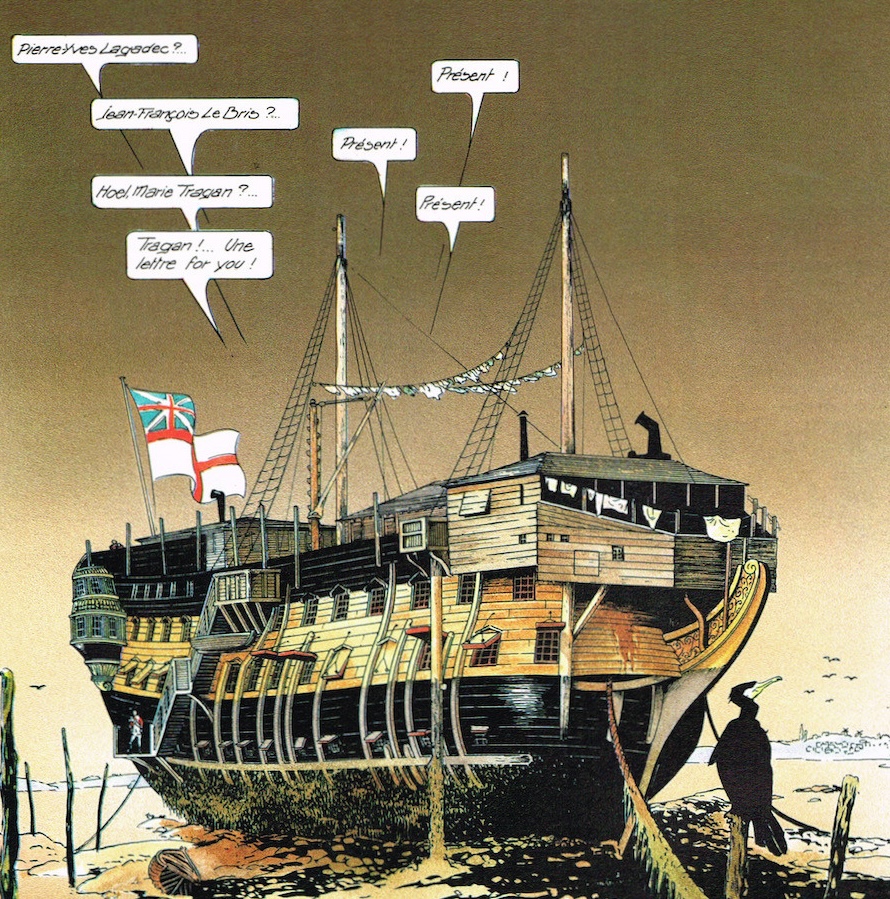
Sometimes violent, sometimes sexual, and always uncompromising, his style embraces reality. The series has also been a major success: by 2009, each volume had sold a million copies in French, and the series had been translated into 18 languages. It is certainly hard to mistake The Passengers of the Wind for a sentimental historical romance or a throwaway potboiler.
◆
Twenty-five years later, Bourgeon resumed the series, with Zabo, Isa's great-granddaughter, as the main character. This second run of albums is not without interest, but lacks the momentum and strength of the first five volumes and was perhaps unnecessary. This article focuses on the saga's first story. ↩︎