
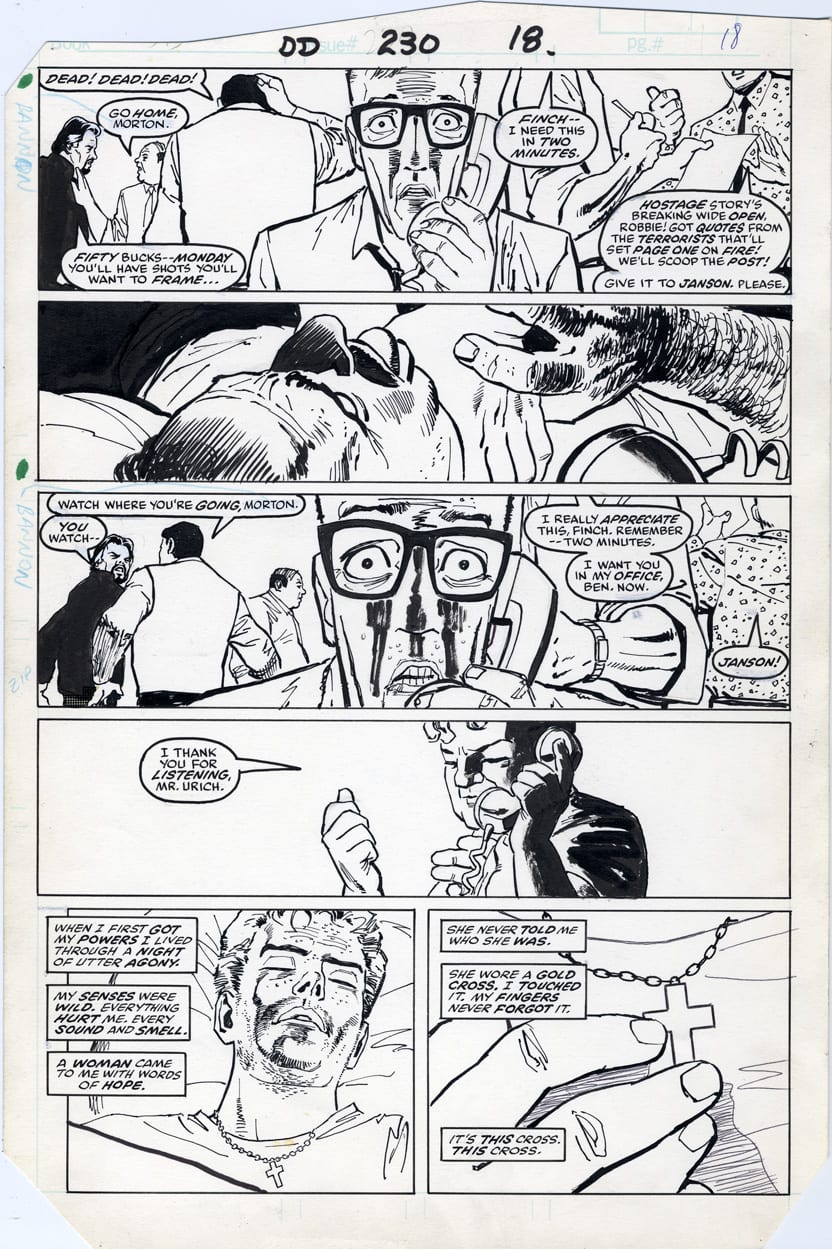
It is not easy to connect the Mazzucchelli of his twenties—the artist on Daredevil, written by Dennis O'Neil and, most notably, Frank Miller (Born Again, 1987), with whom he would also create the celebrated Batman: Year One (also in 1986)—to the Mazzucchelli of Asterios Polyp, his magnum opus, at once a philosophical fable and the culmination of formal experimentation. And yet, at the same time, the evolution feels entirely natural.
« When I was a young artist, I loved mainstream comics and wanted to be part of that group. I didn't think of myself as an author, but as a designer, » Mazzucchelli said.1 After stepping back in the late 1980s, studying lithography among other things, he returned to comics in 1991 as an artist who pushed beyond the boundaries of the page.
Idiosyncrasy
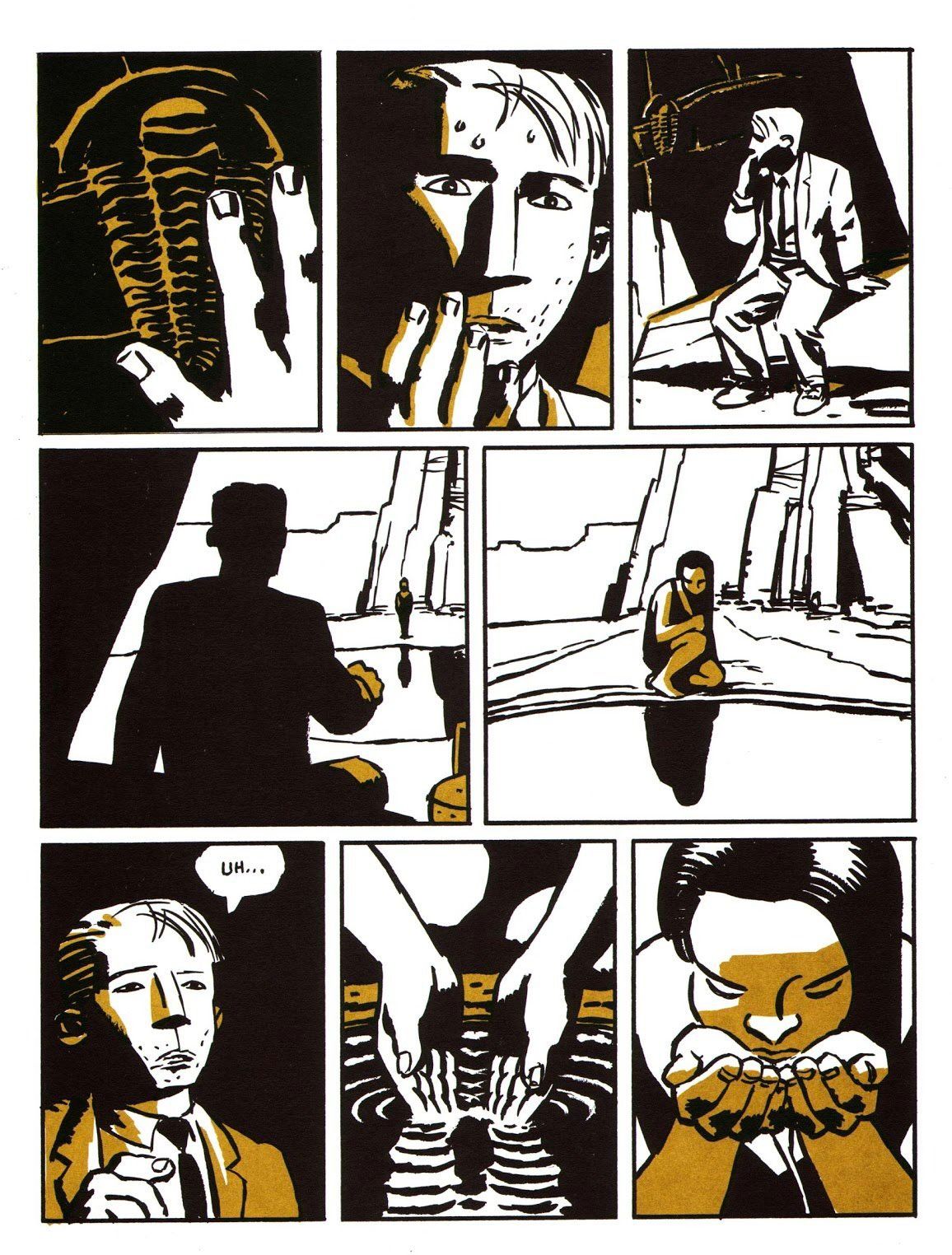
With Rubber Blanket, an anthology published annually from 1991 to 1993 and co-edited with his wife, painter-illustrator Richmond Lewis, Mazzucchelli experimented with drawing, moving largly toward an expressionist style. He also wrote short stories in a distinctly personal voice, while publishing work by Lewis, Ted Stearn, and others.
Far less accessible than the superhero comics he had drawn only a few years earlier, the stories in Rubber Blanket established what would become Mazzucchelli's signature style: an idiosyncratic approach, relatively minimalistic yet rich in psychological detail and visual experimentation.
Mazzucchelli alternates between styles; the author's approach is to adapt it to the needs of the story, not hesitating to return to naturalism when it is called for. Conversely, in Born Again, where the author was still in a form of apprenticeship, a search for page layout, ways of evoking emotions through visual effects, and an ability to produce powerful images without letting them overshadow the narrative were all apparent. Regarding Batman: Year One, the artist would state: « It’s one of the most cinematic stories I’ve done. It’s certainly the most conservative in terms of visual storytelling. »2 A constant balance between dynamics and experimentation.
« When I was a young artist, (...) I didn't think of myself as an author, but as a designer. »David Mazzucchelli
A symbolic language
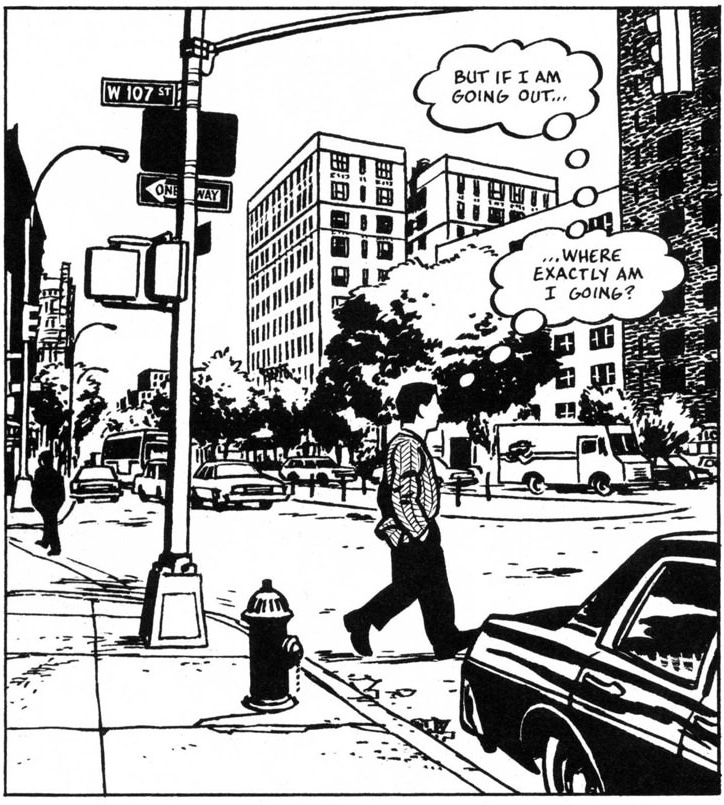
The 1993 American release of Paul Auster's City of Glass brought Mazzucchelli firmly onto critics' radar and became a milestone in the history of the graphic novel. Adapted from Paul Auster's 1985 novel, the project was initiated and coordinated by Art Spiegelman, with Paul Karasik writing the script and Mazzucchelli drawing it.
Anyone who has read City of Glass can appreciate both the difficulty of adapting the novel visually and its potential for images. After all, the novel is primarily about language, and about how Stillman Jr. circumvents it.
Stillman's attempts to communicate inspire some of the adaptation's finest pages. Mazzucchelli draws New York realistically, but the characters, in a manner reminiscent of Tardi, lean toward cartooning; the novel's abstract concepts become a symbolic visual language close to certain forms of contemporary art.
Lack of funding brought Rubber Blanket to an end.3 Mazzucchelli then became interested in manga and spent several months in Japan. Two stories resulted, exploring the relationship between Japanese women and their country's culture: Stop the Hair Nude (in Zero Zero #2) and Midori. During the 1990s, David Mazzucchelli also produced numerous covers for the American cultural magazine The New Yorker and contributed to a few alternative publications.
For many years—almost the entirety of the 2000s—he published nothing, after having already slowed his output considerably in the preceding years. He taught, notably at the School of Visual Arts and the Rhode Island School of Design in New York. He did so with enthusiasm: a gifted communicator, he seemed happy to share his knowledge.4 All the while, he refined what remains his masterpiece, Asterios Polyp, completed in 2009.
The precise gesture
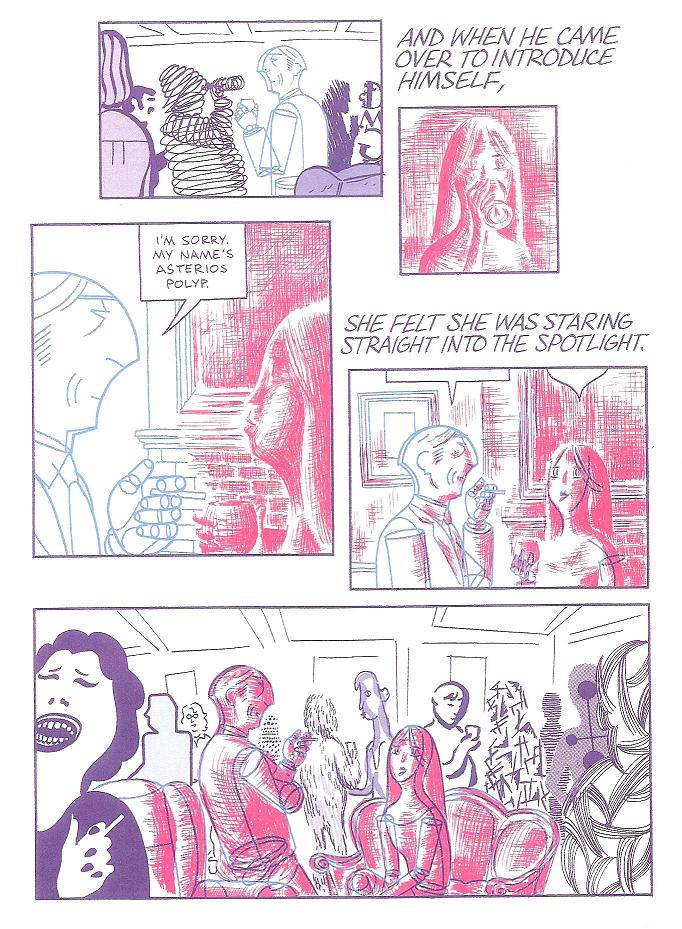
« In most of my work, the most important thing is the precise gesture, the attitude. It's essential to capture them, even with a very simple drawing, » Mazzucchelli said in 1998.5 What stands out most in Asterios Polyp is precisely this union of simplicity and sophistication, this disciplined approach to experimentation.
The story is ultimately very accessible, despite its ambition and broad range of themes and references. Its form is a joyful, diverse patchwork that nonetheless feels perfectly controlled. It is intelligent without being pretentious, intellectual yet universal: the story of a man coming to know himself, but also of the dynamic between reason and emotion, systems and particulars.
The work is expansive and powerful, never forced or mechanical. Mazzucchelli's drawing reaches a new level of clarity and, yes, a kind of magical precision. He plays with color, panel order, and line styles; he shows humor and empathy, remaining perfectly readable while embracing great formal freedom.
Since then, Mazzucchelli has returned to a relative anonymity (though he remains celebrated and admired worldwide). There has been almost no new work, apart from a contribution to Fairy Tale Comics: Classic Tales Told by Extraordinary Cartoonists in 2013. At 66 (in 2026) and now retired, is he preparing a new graphic novel? Or will he continue his inner journey in private? Is it really such a mystery to wonder why an artist no longer expresses himself publicly through his work, when what he has already produced so beautifully exemplifies an art form and its evolution?
Mazzucchelli is one of the few creators whose 1980s work for Marvel and DC is admired just as much as his later, more intellectual work. He fascinates not only through his evolution, but also through his reflections. His aesthetic intuition is matched by an analytical understanding of sequential art. And unlike Asterios and Hana, the two aspects of Mazzucchelli's work communicate perfectly.
◆
Quote from an interview with Andrew Goldman in 2007. ↩︎
Foreword to « Batman: Year One, Deluxe Edition », DC Comics, 2005 ↩︎
A fourth issue, featuring a longer story, was originally planned; that story would become Asterios Polyp 15 years later. ↩︎
This 2020 lecture is a gem of clarity and concision on comics' narrative possibilities and how page composition serves the story. ↩︎